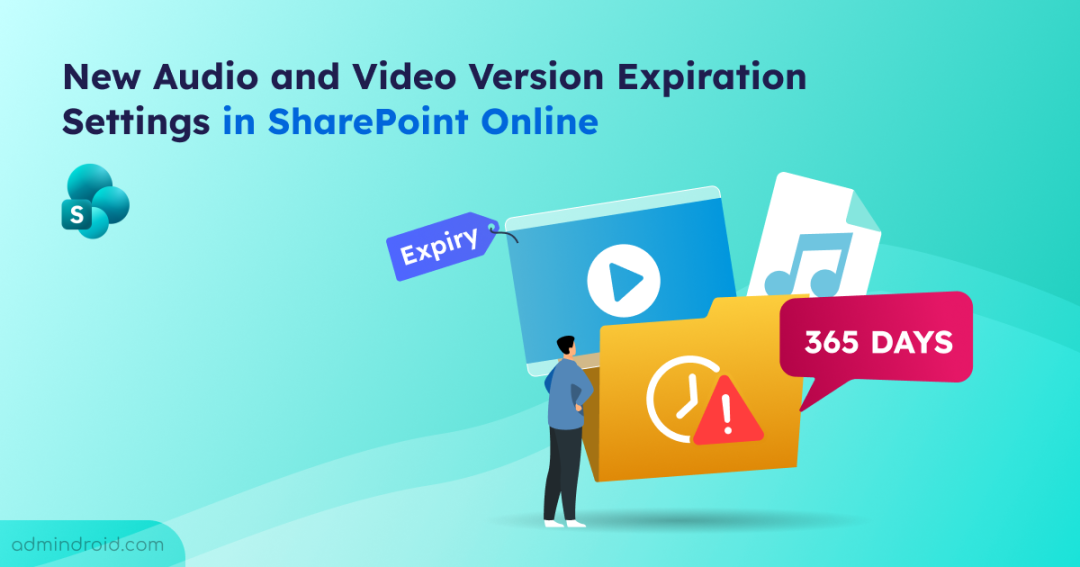
SharePoint Online is a go-to platform for collaboration, where users upload audio files for teamwork and share large videos for training. The catch? Even small updates to these media files generate massive new versions. These media formats typically generate much larger versions than standard documents, causing storage to balloon quickly in libraries with heavy media usage.
To close this gap, Microsoft now introduces version expiration management for audio and video files , allowing admins to set automated expiration policies tailored specifically. Without further delay, let’s break down what’s actually new for admins.
Version Expiration for Audio and Video Files in SharePoint Online
Starting mid-December 2025, SharePoint Online will support version expiration for audio and video files, giving admins more control over how media versions are stored and managed. It helps organizations:
- Reduce unnecessary storage consumption caused by oversized media versions.
- Prevent version sprawl in media-heavy sites and libraries.
- Maintain consistent governance through automated version cleanup.
- Optimize performance and storage costs without turning off versioning.
What’s New in Version Expiration for SharePoint Online Media Files
Microsoft has introduced the following new controls that allow admins to manage the version history of audio and video files more efficiently in SharePoint Online:
- File-type–specific version expiration policies:
Admins can now configure expiration policies tailored specifically for audio and video file types. These settings include defining the maximum number of major versions to retain, choosing default or custom expiration periods, and enabling auto-trim behaviors to remove older versions automatically.
- Policies affect only newly created libraries:
Newly configured policies apply moving forward. Existing libraries require a manual sync if you want the policies to take effect on previously stored media files.
- PowerShell support for policy management:
Microsoft now provides PowerShell cmdlets to set and manage media version expiration policies at the tenant, site, and library levels—offering scalable, automated governance for large environments.
With these new capabilities in place, admins can now use PowerShell to enforce, customize, and automate version expiration policies across their SharePoint Online environment.
Manage Version Expiration for SPO Media Files Using PowerShell
Admins can override settings for audio files, video files, or both. They can also define appropriate expiration periods and choose whether to sync policies across all libraries or apply them to specific scopes using PowerShell.
Note: This feature requires the SharePoint Online Management Shell version 16.0.26712.12000 or later. Additionally, the following cmdlets are part of an experimental feature and are not supported in the current environment.
- Set version expiration overrides for audio and video files at the tenant level:
The Set-SPOTenant cmdlet enables automatic version trimming for audio and video files using the new -FileTypesForVersionExpiration parameter. These version expiration settings are enforced only on new document libraries across the tenant.
|
1 |
Set-SPOTenant -EnableAutoExpirationVersionTrim $true -FileTypesForVersionExpiration @("Video", "Audio") |
- Remove media file version expiration overrides at the tenant level:
Removes any previously configured version expiration overrides for audio and video file types at the tenant level using the -RemoveVersionExpirationFileTypeOverride parameter.
|
1 |
Set-SPOTenant -RemoveVersionExpirationFileTypeOverride @("Video", "Audio") |
You can verify the current configuration by reviewing the VersionPolicyFileTypeOverride property in the output of the Get-SPOTenant cmdlet.
- Configure automatic version trimming at the site level:
Admins can enable automatic version trimming for audio and video files at the site level using the cmdlet below. All new document libraries on this site will apply this configuration.
|
1 |
Set-SPOSite -Identity <SiteUrl> -EnableAutoExpirationVersionTrim $true -FileTypesForVersionExpiration @("Video", "Audio") -ApplyToNewDocumentLibraries |
- Remove media version expiration overrides at the site level:
Use the cmdlet below to remove version expiration overrides for audio and video files at the SharePoint site level.
|
1 |
Set-SPOSite -Identity <SiteUrl> -RemoveVersionExpirationFileTypeOverride @("Video", "Audio") -ApplyToNewDocumentLibraries |
In addition, you can use the Get-SPOSite cmdlet with the new VersionPolicyFileTypeOverride parameter to verify the site-level policies you’ve applied.
- Configure media version trimming for the Documents library:
Run the cmdlet below to enable automatic version trimming for audio and video files in the Documents library.
|
1 |
Set-SPOListVersionPolicy -Site <SiteUrl> -List "<DocumentLibraryName>" -EnableAutoExpirationVersionTrim $true -FileTypes @("Video", "Audio") |
- Sync library settings with tenant or site version history policies:
Sync the document library so that its version history limits, including any file-type overrides, inherit the policies configured at the tenant or site level using the cmdlet below. This is especially useful if the site containing the library has broken inheritance for version history limits.
|
1 |
Set-SPOListVersionPolicy -Site <SiteUrl> -List "<DocumentLibraryName>" -Sync |
- Remove media version expiration overrides at the library level:
Clear any version expiration overrides for audio and video files, allowing the library to use the default version history limits. This can be achieved by executing the cmdlet below.
|
1 |
Set-SPOListVersionPolicy -Site <SiteUrl> -List "<DocumentLibraryName>" -RemoveVersionExpirationFileTypeOverride @("Video", "Audio") |
Additionally, you can use the Get-SPOListVersionPolicy cmdlet to list the version policy settings on the document library. Use the VersionPolicyFileTypeOverride property to view any file-type–specific overrides.
- Start a trim job based on the library’s version history limits:
Starts a trim job that deletes file versions in the Documents library according to its configured version history limits.
|
1 |
New-SPOListFileVersionBatchDeleteJob -Site <SiteUrl> -List "<DocumentLibraryName>" -TrimUseListPolicy |
Moreover, you can use the following cmdlets to track the progress of the settings update job. Note that these cmdlets are currently in preview and may not yet be available in all tenants.
| PowerShell Cmdlet | Description |
New-SPOSiteManageVersionPolicyJob | Starts a background job to apply file version and version history limit updates across all document libraries in the specified site. |
Get-SPOSiteManageVersionPolicyJobProgress | Retrieves the status and progress of a background job initiated by New-SPOSiteManageVersionPolicyJob. |
Remove-SPOSiteManageVersionPolicyJob | Stops the in-progress version policy management job for the specified site. |
Key Points to Consider:
- The general availability rollout of this update begins in mid-December 2025 and is expected to be completed by mid-January 2026.
- Admins should review media-heavy sites and libraries first so they can plan appropriate version expiration policies.
- This update may change how existing data is processed because older audio and video versions can be deleted once thresholds are exceeded. Trimming jobs may also add or clear expiration timestamps.
- Admins should communicate to site owners that older versions may be removed, and only new versions receive expiration stamps unless trimming jobs are executed.
- Retention policies and legal holds block deletions, but trimming jobs fully comply with these restrictions. Therefore, admins should ensure that retention and legal hold settings do not conflict with the planned version expiration policies.
With these updates, admins gain precise control over media version storage, helping reduce bloat and maintain consistent governance across SharePoint Online. While intelligent versioning already optimizes which document versions are kept based on user activity, this new media-specific expiration adds an extra layer of targeted control for libraries that handle large audio and video files.
Microsoft has noted that final documentation will be published before the rollout completes, and we’ll update this post as soon as those details are available. Stay tuned for more insights!