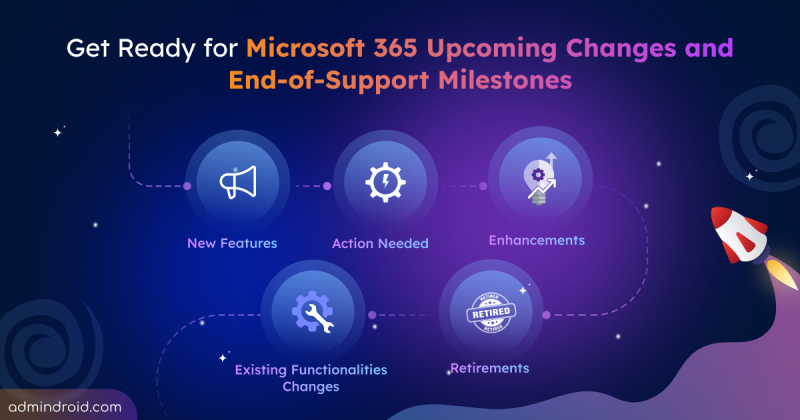
We all know Microsoft continually evolves its platform with enhanced capabilities, improved design, and richer functionality to remain modern and secure. As part of this evolution, Microsoft takes bold steps by retiring key features to encourage users to adopt newer, more secure alternatives. This isn’t an inconvenience—it’s a good call to keep your environment secure and future-ready!
For admins, staying ahead of these retirements isn’t optional; it’s essential. This blog is here to help, covering everything retiring in 2026 and shows you how to act today to avoid being caught off guard tomorrow.

Let’s make it even easier! Here is a timeline infographic that shows all the deprecations in a clear, visual roadmap to see what’s leaving in seconds.
Want a copy you can keep nearby? We also offer a printer-friendly edition that is perfect to stick to your desk, so you can refer to it anytime.
Stay ahead of Microsoft 365 changes with monthly updates!
Get clear insights into new features, functionality changes, and deprecations so you can prepare early and adopt new capabilities with confidence.
Check out: Upcoming Microsoft 365 changes you shouldn’t miss.
⏳ Mid-Jan 2026 – Retirement of Several Microsoft Planner Features (MC1193421)
Microsoft Planner will introduce new features in the Planner app for Teams (desktop and web) as well as Planner on the web, including task chats and custom templates. As part of this update, some legacy features are planned for retirement, while a few others will be temporarily unavailable.
| Retiring features | Features that will be temporarily unavailable |
| Old task comments (basic plans) Whiteboard tab (premium plans) Planner component in Loop Planner integration in Viva Goals iCalendar feed integration | Convert basic plan to premium plan |
Proactive Steps:
- Replace old task comments with the new task chat experience and educate users on @mentions and rich text.
- For the Whiteboard tab (premium plans), continue to access existing content via the Whiteboard app.
- For the Planner component in Loop, use the Task List Control as an alternative.
- For the temporarily unavailable “convert basic plan to premium plan” feature, create new premium plans manually and copy tasks until the feature is restored.
Note: No replacement is currently available for Planner integration in Viva Goals and iCalendar feed integration retirement.
⏳ Jan 31, 2026 – Retirement of IDCRL Authentication in SharePoint and OneDrive (MS Blog)
IDCRL (Identity Client Run Time Library) is a legacy authentication protocol that handles identity tokens for SharePoint Online and OneDrive for Business. As part of the Microsoft Secure Future Initiative, Microsoft will block this legacy client authentication. So, after January 31, 2026, any app that relies on IDCRL will no longer be able to authenticate and access SPO and OneDrive for Business.
Proactive Step:
- Migrate all scripts, and applications to modern authentication protocols such as OpenID Connect or OAuth.
- If necessary, temporarily allow legacy authentication using the following SharePoint Online PowerShell cmdlet before Jan 30, 2026.
|
1 |
Set-SPOTenant -AllowLegacyAuthProtocolsEnabledSetting $true -LegacyAuthProtocolsEnabled $true |
This will allow legacy calls to continue until April 30, 2026. After this date (i.e., May 1, 2026), IDCRL authentication will be permanently disabled and cannot be re-enabled.
⏳ March 1, 2026: End of Support for Exchange Online ActiveSync Versions(MS Blog)
Exchange ActiveSync (EAS) is a Microsoft protocol that lets mobile devices sync email, contacts, and calendar with mailbox. To improve security and reliability, Microsoft will no longer allow devices using EAS versions lower than 16.1 to connect to Exchange Online.
Note: This announcement applies only to Exchange Online and mobile devices using native email apps. Apps like iOS Mail (EAS 16.1 with iOS 10), Gmail, and Samsung Mail (updating to 16.1 soon) will be affected. Outlook Mobile does not use EAS and is not impacted.
Proactive Step:
- Generate a report of devices using older EAS versions and update them to EAS version 16.1 or higher.
To get a list of affected devices, run the below cmdlet after connecting to Exchange Online PowerShell using Connect-ExchangeOnline.
|
1 |
Get-MobileDevice -ResultSize Unlimited | Where-Object {($_.ClientType -eq 'EAS' -or $_.ClientType -match 'ActiveSync') -and $_.ClientVersion -and ([version]$_.ClientVersion -lt [version] '16.1')} | Select-Object UserDisplayName, Identity, DeviceId, DeviceModel | Format-List |
⏳ Mar 18, 2026 – Deprecation of the Legacy Message Trace Support on Reporting Webservice (MS Blog)
The Reporting Webservice is a legacy API used to programmatically retrieve Message Trace data from Exchange Online. Microsoft will retire the Message Trace support on this service because the new Message Trace functionality is not available through it. Going forward, Message Trace data will be accessible only through the new user interface, the Message Trace V2 PowerShell cmdlets and the Microsoft Graph API (coming soon).
Proactive Step:
Replace old Reporting Webservice calls with the new cmdlets: Get-MessageTraceV2 and Get-MessageTraceDetailV2.
⏳ Mar 31, 2026 – Retirement of Office 365 Connectors in Microsoft Teams (MS Blog)
Office 365 connectors enable Teams channels to receive notifications and updates directly from third-party services. However, as part of Microsoft’s Secure Future Initiative, these connectors will be retired to improve the overall security posture of Microsoft Teams. The retirement was originally scheduled for December 2025 but has now been extended to March 31, 2026.
Proactive Step:
To avoid disruption, migrate any existing Office 365 connector webhooks to the Workflows app in Microsoft Teams. This ensures continued message delivery and unlocks newer capabilities like ‘post MessageCards without reformatting’ and ‘send messages or Adaptive Cards to shared or private channels’.
⏳ March 31, 2026 – Deprecation of ‘Require approved client app’ Conditional Access Grant (MS Blog)
The ‘Require approved client app’ control in Conditional Access ensures that users can access corporate resources only through approved client applications. Microsoft will retire this control on March 31, 2026, after which it will no longer be enforced.
Proactive Step:
Transition to the ‘Require app protection policy’ control, which provides the same core functionality along with additional benefits. These include validating the associated Intune app protection policy and enforcing access requirements before a user is granted access.
⏳ Mar 31, 2026 – Retirement of Legacy SharePoint Online CDN Domain (MC1184996)
Microsoft has modernized the delivery of SharePoint Online static assets by moving them to the Azure Front Door (AFD) content delivery network (CDN) under the new domain public-cdn.sharepointonline.com. The older CDN domain, publiccdn.sharepointonline.com, will be retired.
Proactive Step:
Ensure that any hardcoded or referenced links are updated to the new CDN domain before March 31, 2026, to avoid 404 errors.
⏳ April 2026 – Retirement of SharePoint Online Information Management and In-place Records Management Features (MC1211579)
Starting April 2026, SharePoint Online will retire several legacy features used for compliance and data management, including Information Management Policies, In-Place Records Management, document deletion policies (deletion only) and policies for site closure and deletion (deletion only).
These legacy features will no longer be supported, may be removed from the UI, and backend services may stop functioning. Also, configurations will not be available programmatically or through the UI.
Proactive Step:
First, review current usage of legacy features in your organization. Then, plan and migrate to Purview Data Lifecycle Management and Purview Records Management.
⏳ April 2, 2026 – Azure ACS Retirement in Microsoft 365 (MC693863)
Azure Access Control Service (ACS) is a legacy authentication mechanism that allows custom and third-party applications to access SharePoint Online securely without directly handling user credentials. Microsoft will retire the ACS because Microsoft Entra ID now provides a modern, more secure, and future-ready authentication model for SharePoint.
In short, ACS will be fully retired for existing tenants, and any applications that rely on it will stop functioning after April 2, 2026.
Proactive Step:
Use the Microsoft 365 Assessment tool to find any remaining ACS dependencies and migrate to Microsoft Entra ID for authentication.
⏳ Apr 02, 2026 – SharePoint 2013 Workflow and Add-In Retirement (MS Blog)
SharePoint 2013 workflows and SharePoint Add-Ins will no longer be supported and will stop working for existing tenants starting April 2, 2026.
Proactive steps:
- Migrate SharePoint 2013 workflows to Power Automate or other supported workflow solutions.
- Use the Microsoft 365 Assessment tool to identify SharePoint Add-In usage in your tenant, and then disable SharePoint Add-Ins using the SharePoint Online Management Shell.
⏳ July 2026 – SharePoint Alerts Retirement (MS Blog)
SharePoint Alerts are email notifications that help users stay informed when items in SharePoint lists, libraries, folders, or files are added, updated, or deleted. To enforce modern notification solutions, Microsoft will fully retire SharePoint Alerts. Existing alerts can no longer be modified and will eventually stop working.
Proactive Step:
Microsoft recommends migrating existing SharePoint Alerts to Power Automate or SharePoint Rules, which provide more flexible and modern notification capabilities. Use the Microsoft 365 Assessment tool to identify current alert usage and plan the migration.
⏳ Sep 30, 2026 – Retirement of Project Online (MS Blog)
Microsoft is retiring Project Online on September 30, 2026, due to its legacy architecture and limited support for modern Microsoft 365 capabilities such as real-time collaboration, AI-driven project insights, and deep integration with Teams.
Proactive Step:
Evaluate and plan a transition to supported alternatives such as Planner (with premium features and Copilot-powered Project Manager agent), Project Server Subscription Edition for advanced PPM needs, or Dynamics 365 Project Operations for project delivery and financial management.
⏳ Oct 2026 – End of Support of Microsoft Publisher (MS Blog)
Microsoft Publisher will be retired in October 2026. It will no longer be part of Microsoft 365, on-premises Office suites will stop supporting it. Also, users will no longer be able to open or edit Publisher files.
Proactive Step:
Organizations should transition from Publisher to supported Microsoft 365 apps. Common tasks like creating templates, labels, calendars, business cards, and print-ready documents can be handled in Word or PowerPoint, which provide modern design and formatting tools.
⏳ Oct 1, 2026 –Risk Policies Retirement in Entra ID Protection (MS Blog)
Microsoft will retire the user risk and sign-in risk policy experience in Microsoft Entra ID Protection on October 1, 2026. In clear, these risk-based controls will no longer be managed through the Entra ID Protection interface.
Proactive Step:
Create risk-based Conditional Access policies which is the recommended and supported approach for risk-based access enforcement.
⏳ Oct 1, 2026 – Deprecation of Exchange Web Services (MS Blog)
Exchange Web Services (EWS), a legacy API for programmatically accessing Exchange mailboxes, will be deprecated. Starting October 1, 2026, EWS requests to Exchange Online will no longer be supported. This change applies only to Microsoft 365 and Exchange Online; on-premises Exchange Server mailboxes will continue to support EWS fully.
Proactive Step:
Migrate applications to Microsoft Graph, which provides modern capabilities, stronger security, and ongoing support.
⏳ Oct 13, 2026 – End of Support for Office LTSC 2021 (MS Blog)
Following the end of support for Office 2013 and Office 2019, Microsoft has announced that Office LTSC 2021 will also reach end of support on October 13, 2026. After this date, Microsoft will no longer provide security updates, bug fixes, or technical support for Office LTSC 2021.
Proactive Step:
Migrate to Microsoft 365 Apps or upgrade to Office LTSC 2024.
⏳ Oct 28, 2026 – Retirement of Microsoft Entra Privileged Identity Management Iteration 2 (beta) APIs (MS Blog)
Microsoft has released multiple versions of Privileged Identity Management (PIM) APIs over time. The second iteration of the PIM API, used for managing Azure resources and Microsoft Entra roles, has been replaced by a newer and more advanced iteration. So, the PIM API iteration 2 for Azure resources and Microsoft Entra roles will stop returning data from October 28, 2026.
Proactive Step:
Update any integrations or automation to use the latest Azure REST PIM API for Azure resources and the PIM API iteration 3 for Microsoft Entra roles.
⏳ Dec 2026 – End of Support for the Microsoft Store Installation Type of Microsoft 365 Apps (MS Blog)
Microsoft 365 Apps can be installed on Windows PCs in different ways. One method is the Microsoft Store installation type, where apps such as Word, Excel, and Outlook are installed and updated through the Microsoft Store.
Microsoft is ending support for this installation type in favor of Click-to-Run, a single, secure, and centrally managed deployment model. As a result, after December 2026, Microsoft 365 Apps installed via the Microsoft Store will no longer receive security updates.
Proactive Step: Upgrade the installation type of the Microsoft 365 Apps from the Microsoft store to Click-to-Run.
That’s it for the major retirements coming in 2026. But there’s one more important update that every admin should know about:
⏳ Dec 2026 – Unavailabilty of Basic Authentication for Client Submission in Exchange Online (MS Blog)
By the end of December 2026, SMTP AUTH with Basic Authentication will be disabled by default for existing tenants. Admins can still enable it if absolutely necessary. However, after December 2026, Basic Authentication for SMTP AUTH will no longer be available by default. The deprecation was originally scheduled for March 2026 but has now been extended to December 2026.
Proactive Steps:
- Move applications and devices to OAuth-based authentication for SMTP AUTH.
- If basic authentication is still required for sending email, consider alternative solutions such as High Volume Email for Microsoft 365, Azure Communication Services for Email, or an on-premises Exchange Server in a hybrid configuration.
⏳ Attention Needed (July 2026): Major Microsoft 365 Pricing Update (MS Blog)
Microsoft recently announced a significant pricing update for Microsoft 365 plans, effective July 1, 2026. This is one of the largest price changes in years, coming as the suite adds new AI, security, and device management features.
What’s changing:
- Plans like Business Basic, Enterprise E3/E5 and few others will see price increases.
- Increase range: approximately 5% to 33%, depending on the plan.
- Nonprofits will also see higher prices, since their discounts are tied to commercial rates.
- Government plans like Office 365 G3/E3 (GCC, GCC High, DoD) will increase upto 13%, with federal rules limiting the first-year hike to 10%.
Proactive Step:
Review your Microsoft 365 usage, optimize any idle licenses, and evaluate whether the latest features justify your current plan. Planning ahead now ensures efficiency and helps avoid surprises with the upcoming price updates.
We hope this summary highlights all the major retirements and updates you need to know. Plan ahead to avoid disruptions, and if you have any questions, please share them in the comments. We’re here to help!